The patrols do more than just bear witness. Orr has had to bandage terrified people beaten by and fleeing DC’s Metropolitan Police Department, returning home at sunrise with his clothes stained with blood.
Another time, Orr said, he saw officers trying to arrest a man over a burned-out taillight “while his two young children sat alone in the car, crying.” “Thankfully,” he explained, “our group managed to put pressure on these officers [phone cameras out and ready], and they eventually let the man and his children go.” That happens more often than you’d think. Weapons and a free pass to beat people doesn’t mean that they have the resolve to do this awful work when confronted with people with cameras.
Recently a night patrol captured ICE and the MPD arresting without cause a Black corporate attorney and West Point graduate named Paul Bryant at 2:00 am in Logan Circle. The police and feds on the scene asked his name and why he was out at that hour. Bryant refused to answer, as is his right. He was released the next day after the judge excoriated the DC prosecutors. A lawsuit is now expected.
The night patrols are clearly making a difference. Many of the occupying forces have shifted their tactics from walking around and harassing people to a “jump out” strategy in which they stay in their cars until screeching to a halt and storming out to accost people. Their selections are, no doubt, driven by shameless racial profiling. No rights are read, no badges shown. When it’s ICE, their faces are covered. These terrifying “jump-outs” are not new to Washington, DC; the DC Justice Lab has long called them “DC’s scarier version of stop-and-frisk.” They are supposed to be unconstitutional. Yet it’s a sign of the effectiveness of the night patrols that they are resorting to this tactic in order to avoid people’s questions, cameras, and assertion of rights. The armed occupiers aren’t defending the Constitution. They fear it.
While one tactic is to work in smaller groups like Orr, another has been to mobilize cop-watch rallies or “Defend the District” go-go shows in order to draw in people—especially youth—for larger showings of strength. “Go-go is the native music of Washington, DC,” one attendee told us. “This music has been used for our resistance time and time again.”
The attendee added that there is “joy in the revolution,” and that it is important to show the occupation forces that they are unafraid: “There are police everywhere. We are outside. We are not scared of you. This is our home!”
At one such event, Frankie Seabron, an organizer with Harriet’s Wildest Dreams (HWD) said, “We need to keep Black people in this city safe. We need to keep youth, migrants, and our unhoused people safe. Because those are the people who this fascist system is targeting.”
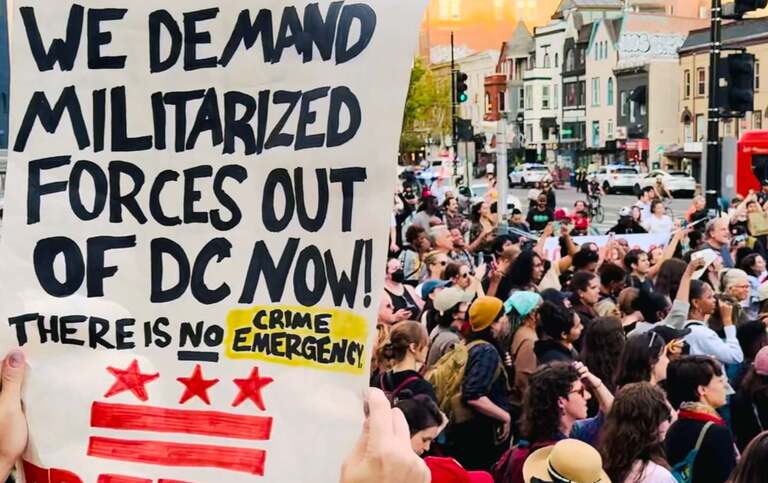
Last Saturday, the DC Against Trump Coalition (DCAT) started a rally at 14th and U in one of DC’s curfew zones, where minors are barred from gathering after 8 pm, allowing police to target Black youths as soon as the sun goes down. The event ended with groups of protesters patrolling different areas of DC up until 4 am.
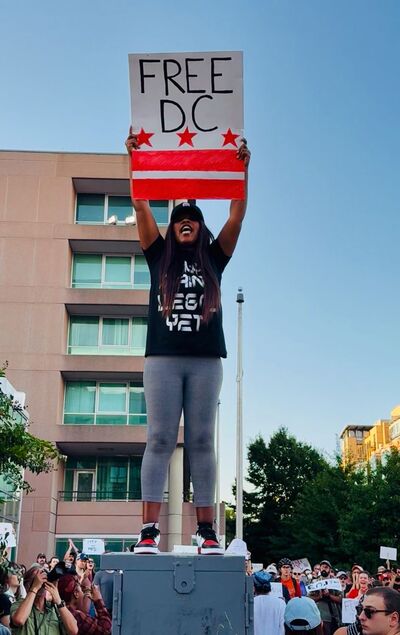
This is becoming its own method of organizing. During the last week, the night patrols have grown in number and frequency. They often occur after mobilizing rallies from organizations and coalitions like FreeDC, HWD, DCAT, and the independent DC media group Liberation Lens. It can be dizzying keeping up, but FreeDC’s calendar is a good start.
This week a group of fed-up military veterans associated with the group FLARE USA, which stands for For Liberation And Resistance Everywhere, have joined in on the overnight cop-watch efforts. “We are also here to disrupt ICE Raids,” retired marine Mathew Gordon told us. “ICE is kidnapping people off the streets, and we are doing everything they possibly can to make their lives miserable.” These vets go to ICE checkpoints and pepper the agents with harsh questions on camera about the immorality and illegality of their actions until they leave.
When FLARE vets approach National Guard members, they employ a calmer, less confrontational strategy, educating them about their rights to challenge orders they think could be illegal. Gordon said this was more effective since “most are much younger and don’t want to be here.” FLARE will have a series of actions next week.
“We feel that deploying the US military to the streets of Washington, DC, to police our own citizens is unconstitutional,” Gordon told us. “We took an oath to support and defend this country against all enemies foreign and domestic—that is our oath, and that oath doesn’t expire.”
There’s a common and familiar refrain at protests, which in DC has become more than slogan—it’s an organizing principle. Ty Hopson Powell at the Defend the District go-go rally repeated it to us as he explained the importance of grassroots organizing: “It is us that will save us! It is the message that we have been saying on the streets for years as frontline organizers who are the most invested in this work. WE WILL SAVE US! They won’t save us.”
Local government institutions certainly will not, as Washington’s Mayor Muriel Bowser has made perfectly clear. Even though 80 percent of the city feels “less safe” since the occupation began, Bowser is in open collaboration with Trump, praising him earlier this week for what she pointedly calls “the surge” and undercutting not only the people she represents but also other cities facing down this regime’s threats to make urban militarization the new normal.
The failures of Bowser and the city government to stand up for its residents means Powell’s words have never rang truer. No one is coming to save the people in DC—and yet, no one should bet against the people of DC saving themselves. “What does keep us safe is people showing up for one another,” said Orr. “Cop watch, night patrols, mutual aid—these are ways communities step in to protect each other when institutions only cause harm. When we document, de-escalate, offer medical care, or simply stand beside someone in crisis, we’re proving that safety comes from solidarity, not surveillance.”
Doing this kind of work empowers communities, and the videos expose the truth of life under occupation more effectively than a thousand empty speeches. “This isn’t about individuals playing hero,” said Barr. “It’s about collective accountability and care. The most important thing is to start where you are, with the skills and resources you already have.”